The Holy Church of Iggy the Inuit
Iggy was one of Syd Barrett's girlfriends in 1969. She is most famous for being the model on the Syd Barrett album: 'The Madcap Laughs'. Nicknamed Iggy the Eskimo, it was rumoured she was part Inuit. One day she disappeared out of Syd's life and has not been heard of ever since.
And then the Holy Church of Iggy the Inuit started to mess with things...
August 2008: A fashion documentary from 1967 featuring Ig is discovered.
January 2009: JenS reveals how Syd Barrett and Ig first met.
February 2010: World exclusive: Ig is alive and well and living in England.
March 2010: Gretta Barclay, a friend of Syd, Ig and JenS, remembers 1969.
January 2011: The Mark 'Mojo' Blake Iggy interviews are published:
Iggy The Eskimo Phones Home (Mojo 207 article - hosted at the Church)
The Strange Tale Of Iggy The Eskimo - part 1 (hosted at Mojo)
The Strange Tale Of Iggy The Eskimo - part 2 (hosted at Mojo)
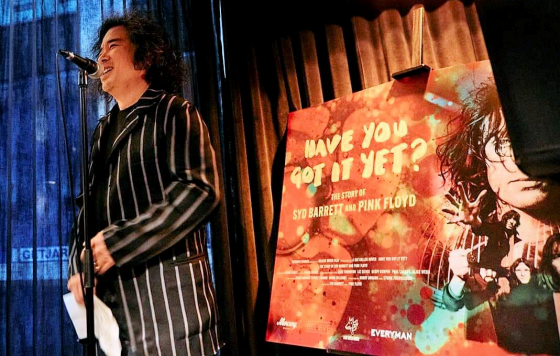
April 2011: Iggy surprises friends and foes by visiting the 'Barrett' book launch, her first public appearance in over 30 years: Iggy at the Exhibition.
2012-05-11
RIP Clive Welham: a biscuit tin with knives
On Wednesday, 9 May 2012, it was reported that Clive
Welham passed away, after having been ill for a long time.
50 years earlier, he was the one who introduced a quiet, shy boy to Roger 'Syd' Barrett at the Cambridge College of Art and Technology. The boys had in common that they both liked to play the guitar and immediately became friends, that is how Syd Barrett and David Gilmour met and how the Pink Floyd saga started.
Perse pigs and County cunts *
Just like in the rest of England, Cambridge was a musical melting pot in the early sixties with bands forming, merging, splitting and dissolving like bubbles in a lava lamp.
Clive 'Chas' Welham attended the Perse Preparatory School for Boys, a private school where he met fellow student David Gilmour. As would-be musicians they crossed the social barriers and befriended pupils from the Cambridge and County School for Boys, meeting at street corners, the coffee bars or at home were they would trade guitar licks. Despite their two years age difference Clive was invited to the Sunday afternoon blues jam sessions at Roger Barrett's home and in spring 1962 this culminated in a 'rehearsal' band called Geoff Mott & The Mottoes. Clive Welham (to Julian Palacios):
There was Geoff Mott [vocals], Roger Barrett [rhythm guitar], and “Nobby” Clarke [lead guitar], another Perse boy. I met them at a party near the river. They’d got acoustic guitars and were strumming. I started picking up sticks and making noise. We were in the kitchen, away from the main party. They asked me if I played drums and I said, “Not really, but I’d love to.” They said, “Pop round because we’re getting a band together.”
Clive Welham (to Mark Blake):
It was quite possible that when me and Syd first started I didn't even have any proper drums and was playing on a biscuit tin with knives. But I bought a kit, started taking lessons and actually got quite good. I can't even remember who our bass player was...
Although several Pink Floyd and Syd Barrett biographies put Tony Sainty as the Mottoes' bass player Clive Welham has always denied this: “I played in bands with Tony later, but not with Syd.”
Another hang-around was a dangerous looking bloke who was more interested in his motorbike than in playing music: Roger Waters. He was the one who designed the poster for what is believed to be The Mottoes' only public gig.
After Clive Welham had introduced David Gilmour to Syd Barrett, David became a regular visitor as well. Surprisingly enough Syd and David never joined a band together, starting their careers in separate bands. Although they were close friends it has been rumoured there was some pubertal guitar playing rivalry between them.
1962: The Ramblers
The Mottoes never grew into a gigging band and in March 1962 Clive Welham, playing a Trixon drum kit, stepped into The Ramblers with Albert 'Albie' Prior (lead guitar), Johnny Gordon (rhythm guitar), Richard Baker (bass) and Chris ‘Jim’ Marriott (vocals).
The Ramblers’ first gig was at the United Reformed Church Hall on Cherry Hinton Road. They used their new Watkins Copycat Echo Chamber giving them great sound on The Shadows’ Wonderful Land and Move It.
The Ramblers soon acquired a certain reputation and gigged quite a lot in the Cambridge area. One day Syd Barrett asked 'Albie' Prior for some rock'n roll advice in the Cambridge High School toilets: “...saying that he wanted to get into a group and asking what it involved and in particular what sort of haircut was best.”
Unfortunately the responsibilities of adulthood crept up on him and lead guitarist 'Albie' had to leave the band to take a job in a London bank. On Tuesday, the 13th of November 1962, David Gilmour premiered at a gig at the King's Head public house at Fen Ditton, a venue were they would return every week as the house band. Gilmour had joined two bands at the same time and could also be seen with Chris Ian & The Newcomers, later just The Newcomers. Notorious members were sax-player Dick Parry, not unknown to Pink Floyd anoraks and Rick Wills (Peter Frampton's Camel, Foreigner and Bad Company).
Memories have blurred a bit but according to Glenn Povey's Echoes Gilmour's final gig with The Ramblers was on Sunday, 13 October 1963. Beginning of 1964 The Ramblers disbanded but three of its 5 members would later resurface as Jokers Wild.
1963: The Four Posters
But first, in autumn 1963, a band known as The Four Posters was formed, although it may have been just a temporarily solution to keep on playing. David Altham (piano, sax & vocals) and Tony Sainty (bass & vocals) were in it and perhaps Clive Welham (drums). Unfortunately their history has not been documented although according to Will Garfitt, who left the band to pursue a painting career, they played some gigs at the Cambridge Tech, the Gas Works, the Pit Club and the university. Contrary to what has been written in some Pink Floyd biographies John Gordon was never involved:
I was never in The Four Posters. Clive and I were together in The Ramblers, and we left together to join Dave, David and Tony to create Jokers Wild. I don't know whether Dave and Tony came from The Newcomers or The Four Posters...
1964: Jokers Wild
The Ramblers, The Four Posters and The Newcomers ended at about the same time and the bands more or less joined ranks. Renamed Jokers Wild in September 1964 it was at first conceived as an all-singing band. “We were brave enough to do harmony singing that other groups wouldn’t attempt, including Beach Boys and Four Seasons numbers”, confirmed Tony Sainty. The band had good musicians, all of them could hold a tune, and they soon had a loyal fanbase. They became the house-band at Les Jeux Interdits, a midweek dance at Victoria Ballroom. Clive Welham: “We came together in the first place because we all could sing.”
Some highlights of their career include a gig with Zoot Money's Big Roll Band, The Paramounts (an early incarnation of Procol Harum) and a London gig as support act for The Animals. This last gig was so hyped that a bus-load of fans followed them from Cambridge to the big city of London.
1965: Walk Like A Man
Mid 1965 the band entered the Regent Sound Studios in Denmark Street, London. They recorded a single that was sold (or given) to the fans containing Don’t Ask Me What I Say (Manfred Mann) and Big Girls Don’t Cry (The Four Seasons). Out of the same session came a rather limited one-sided LP with three more numbers: Why Do Fools Fall in Love, Walk Like a Man and Beautiful Delilah. This is the only 'released' recording of Jokers Wild although there might be others we are not aware of. Peter Gilmour (David's brother) who replaced Tony Sainty on bass and vocals in autumn 1965 commented this week:
Sad news. A great bloke. I'll replay some of those old recordings doing Four Seasons and Beach Boys numbers with his lovely clear falsetto voice.
Somewhere in October 1965 they played a private party in Great Shelford together with an unknown singer-songwriter Paul Simon and a band that was billed as The Tea Set because Pink Floyd sounded too weird for the highbrow crowd. Clive Welham:
It was in a marquee at the back of this large country house [that can, by the way, be seen on the cover of the Pink Floyd album Ummagumma, FA]. I sat on and off the drum kit because of my wrist problems. Willie Wilson sat in on drums and I came to the front on tambourine.
The musicians enjoyed themselves, jamming with the others and Paul Simon - 'a pain in the arse', according to drummer Willie Wilson - joined in on Johnny B. Good. A couple of days later Jokers Wild supported Pink Floyd again, this time at the Byam Shaw School, Kensington, London. Each band was paid £10 for that gig.
1965: the Decca tapes
By then Jokers Wild were seriously thinking of getting professional. They were not only known by the locals in Cambridgeshire, but did several society parties in London as well. Also the military forces had discovered them: Jokers Wild was invited for the Admiral League dance at the Dorchester Hotel in London and played several dances at the RAF and USAF bases of Mildenhall, Lakenheath, Alconbury and Chicksands. Their repertoire changed as well, shifting more towards soul, R&B and Tamla Motown. Libby Gausden: “How we danced to David Gilmour, Peter Gilmour, David Altham, John Gordon, Tony Sainty and dear Clive xxx.”
Some promoters were sought for and the band recorded a single for Decca: You Don’t Know Like I Know (Sam and Dave) / That’s How Strong My Love Is (Otis Redding), but unfortunately it was never released because the original version by Sam and Dave had already hit the UK market.
After the Decca adventure the original band slowly evaporated over the next few months. Peter Gilmour left (probably after the summer of 1966) to concentrate on his studies. Clive Welham had difficulties combining his full time job with a semi-professional rock band and had some medical problems as well. John Gordon further explains:
Clive [Welham] became unable to play any more (with a wrist complaint) and was replaced by Willie Wilson... and that line-up continued for some time. It was later still that Tony Sainty was replaced by Rick [Wills]... and then, when the band was planning trips to France, I had to 'pass' to finish my degree at college.
1966: Bullit & The Flowers
Now a quartet with David Altham, David Gilmour, John 'Willie' Wilson and newcomer Rick Wills on bass, they continued using the known brand name, a trick Gilmour would later repeat (but slightly more successful) with Pink Floyd, touring around Spain, France and The Netherlands. Another failed attempt to turn professional made them temporarily change their name to Bullit and when David Altham also left the remaining trio continued as The Flowers, mainly playing in France. Around camp-fires on this planet it is told how a sick (and broke) David Gilmour returned to London, just in time to get a telephone call from Nick Mason, asking if he had a few minutes to spare.
2012: Nobody Knows Where You Are
Not a lot is known of the later career of Clive Welham. He did, however, become a successful singer with a local Cambridge band Executive Suite. His last outing was on the Cambridge Roots of Rock of 2008.
On behalf of The Holy Church of Iggy the Inuit I would like to offer our sincere sympathies to the Welham family.
Jokers Wild #1 (October 1964 - May 1966 / Source: Glenn Povey)
David Altham: guitar, saxophone, keyboards, vocals
David Gilmour:
guitar, vocals, harmonica
John Gordon: rhythm guitar, vocals (1964 to
late 1965)
Tony Sainty: bass, vocals (1964 to early 1966)
Peter
Gilmour: bass, vocals (early 1966)
Clive Welham: drums, vocals (1964
to late 1965)
John 'Willie' Wilson: drums (from late 1965)
Jokers Wild #2 (Summer 1966 - Summer 1967 / Source: Glenn Povey)
AKA
Bullit (3 summer months in 1966 at the Los Monteros hotel in Marbella?)
AKA
The Flowers (end 1966)
David Altham: rhythm guitar (to December 1966)
David Gilmour: guitar,
vocals
Rick Wills: bass (from January 1967)
John 'Willie' Wilson:
drums
Listen to Jokers Wild on YouTube:
First
three tracks ("Why Do Fools Fall in Love", "Walk Like a Man", "Don't
Ask Me (What I Say)")
Last
two tracks ( "Big Girls Don't Cry", "Beautiful Delilah")
Jokers
Wild EP (5 tracks)
Many thanks to: Viv Brans, Libby Gausden, John Gordon, Peter Gilmour, Jenny Spires & I Spy In Cambridge. All pictures courtesy of I Spy In Cambridge.
Note: Perse pigs and County cunts: friendly nicknames the pupils of these rivaling schools gave to each other. (Back to text.)
Sources (other than the above internet links):
Blake, Mark: Pigs
Might Fly, Aurum Press Limited, London, 2007, p. 22-23, 34.
Dosanjh,
Warren: The music scene of 1960s Cambridge, Cambridge, 2012, p.
42, 46-47. Free download
at: I
Spy In Cambridge.
Gordon, John: Corrections re Jokers Wild,
email, 2012-05-12.
Palacios, Julian: Syd Barrett & Pink Floyd:
Dark Globe, Plexus, London, 2010, p. 27-28, 31.
Povey, Glenn: Echoes,
the complete history of Pink Floyd, 3C Publishing, 2008, p. 13,
20-24, 29.
2012-03-26
Formentera Lady
Despite the fact that the sixties children of the revolution all wanted
to express their individualism and refused to be a part of the square 9
to 5 world they all managed to show up at the same places, dress
virtually the same and take the same chemical substances.
This also applied for their holidays. Although they had been seeing each other the whole year in old rainy England, in summer they would pack their bags and flee – en masse – to the same cool (but sweaty) locations, following the so-called Hippie Trail.
The Hippie Trail extended to the Himalayas and several Cantabrigian hipsters made it to the Indies, looking for a guru who would teach them things a local vicar couldn't teach them. Paul Charrier, one of the Cantabrigian mods, beats or whatever denomination they liked that week, was one of the first to witness this. When he returned to England and opened his bag of tricks, he managed to convert a few others to the narrow path of Sant Mat, but others, like Storm Thorgerson and Matthew Scurfield, opposed to this 'wave of saccharine mysticism hitting our shores' (see also: We are all made of stars).
India and Pakistan were long and hazardous journeys and for those who only had a few weeks to spend there were always the Balearic islands where they would meet at La Tortuga or La Fonda Pepe.
Some 700 hippies arrived in Formentera in 1968 and by the summer of 1969 there were already 1,300, almost one for every 2.5 islanders. They didn’t stay all year round but were usually university students spending their holidays on the island. In 1970, Franco’s regime threw all 3,000 of them off Ibiza and Formentera. According to the regime, the hippies gave the place a bad name, but the islanders didn’t agree – for them the hippies were simply tourists. (Taken from: Thinkspain.)
Of course the islands of Formentera and Ibiza (Balearic Islands) already had some reputation of their own. The place not only gained popularity by (American) writers and artists after the second world war for its mild climate, but also because it was a central drug smuggling point. The heroes of Beat literature not only liked the bohemian's life, but in their quest for nonconformity they also actively sought contact with 'the perilous margins of society - pimps, whores, drug dealers, petty thieves'.
Quite some Dutch artists visited the place, for one reason or another. The proto-hippie-folk singing duo Nina & Frederik (Dutch-Danish, in fact), who had some hits in the fifties and early sixties, lived there. In his later life Frederik Van Pallandt attempted a career as drug smuggler and his murder in 1994 may have been a direct result. Other artist included poet Simon Vinkenoog, author Jan Cremer and Black & Decker trepanist Bart Huges. The sixties saw visits from the Beatles, the Stones and in their wake some beautiful people from London (for a more detailed list: Ibiza in the beatnik & hippie eras.)
1963
David Gale, his girlfriend Maureen, Dave Henderson, Storm Thorgerson and John Davies went to Ibiza in 1963 for their holidays where they visited Formentera island for a day. Back at home they all decided to have another holiday there.
1965
Mary Wing (and her friend Marc Dessier) found Formentera so beautiful that in 1965 they decided to stay there.
1967
Nick Mason acknowledges that after the '14 hour technicolour dream' (29 April 1967) the band was very tired and that Syd showed more severe symptoms than the others. Despite all that the continuous, eight days a week, gigging went on with the mythical Games For May concert two weeks later (12 May), the memorable Hans Keller BBC interview (14 May) and the See Emily Play recording session (18 May). There were nearly daily concerts or recording sessions between May and June of that year, but little by little cracks started to appear in their overcrowded agenda.
June, 11: two cancelled concerts in Holland
June, 18: public
appearance on a bikini fashion show for Radio London, cancelled
June,
24: two cancelled concerts in Corby and Bedford
June, 25: two
cancelled concerts in Manchester
On Thursday, July the 27th 1967, the Pink Floyd mimed (for the third time) on the Top Of the Pops show although Barrett was rather reluctant to do it. The next day they had a recording session for the BBC, but apparently Syd was seen leaving the block when it was their turn. This time the band and its management took Syd's behaviour seriously and decided to cancel all August gigs (with the exception of some studio recording sessions).
Now what would you do when the lead singer of your band has got mental problems due to his abundant drug intake? You send him to a hippie, drug infested, island under the supervision of a psychedelic doctor who thinks that LSD has been been the best invention since masturbation.
Sam [Hutt, aka Smutty] was the underground's very own house doctor, sympathetic to drug users and musicians: as Boeing Duveen And The Beautiful Soup and later Hank Wangford, Sam was able to introduce a performer’s perspective. (Nick Mason)
In 1969 Smutty would have his medical office at Jenny Fabian's apartment: “I did find it a bit weird though, trying to lie around stoned listening to the sounds of vaginal inspections going on behind the curtain up the other end of the sitting-room."
After a first attempt in the studio on Scream
Thy Last Scream, Pink Floyd finally went on holiday for the second
half of August. Syd Barrett, Lindsay Corner, Rick Wright, Juliette Gale
(Wright), Dr. Sam Hutt, his wife and baby went to Formentera while Roger
Waters and Judy Trim (Waters) headed for Ibiza. They all had a good
time, except for Barrett who – during a storm - panicked so hard he
literally tried to climb the walls of the villa, an anecdote that is so
vehemently trashed by biographer Rob
Chapman that it probably did happen.
In retrospect the decision to take a hippie doctor on holiday wasn't that stupid. One of the underlying ideas was that he would be able to communicate with Syd on the same level. The band, conscientiously or not, were also aware that 'there was a fear that sending Syd to a [traditional] doctor for observation might lead to his being sectioned in a mental hospital'.
In those days most care centres in Great Britain were still Victorian lunatic asylums where medical torture was mildly described as therapy. At least these were the horrid stories told by the people who had been so lucky to escape.
He showed me to the room that was to be mine. It was indeed a cell. There was no door knob on the inside, the catch had been jammed so that the door couldn't be shut properly, the window was high up in the wall and had bars over it, and there was only a standard issue bed and locker as furniture. (William Pryor)
Nobody wanted this to happen to Syd, but a less prosaic thought was this would have meant the end of the band, something that had to be carefully avoided. “The idea was to get Syd out of London, away from acid, away from all his friends who treated him like a god.”, Rick Wright explained but in reality Dr. Hutt, and the others, merely observed Syd Barrett, catatonic as ever and still 'munching acid all the time'. Nick Mason, in his usual dry style: “It was not a success.”
Whoever thought that giving Barrett a few weeks of rest was going to evaporate the demons from his brain must have been tripping himself and on the first of September the agenda was resumed as if nothing had happened. The first 6 days were filled with gigs and recording sessions. Three days later a Scandinavian tour with the legendary Gyllene Cirkeln and Starclub gigs, followed by an Irish Tour and later, in October, the disastrous North American Tour...
Although the previous paragraphs may seem harsh they are not meant to criticise the people nor their actions. It is easy to pinpoint what went wrong 45 years ago, but as it is impossible to predict an alternative past we will never know if any other action would have had a different or better effect. The Reverend is convinced that Syd's friends, band members and management tried to do their best to help him, but unfortunately they were running in the same insane treadmill as he was. Syd wasn't the only one to be exhausted and at the same time the atmosphere was imbibed with the 'summer of love' philosophy of respecting someone's personal freedom, even if it lead to self-destruction...
1968
In 1968 Aubrey 'Po' Powell (Floydian roadie and later Hipgnosis member) visited the Formentera island together with some friends.
I first came here forty-one years ago [interview taken in 2009, FA] with David Gilmour, and then the year afterwards with Syd Barrett. The first year I came to Formentera I stayed about four months living like a hippie, and I just fell in love with it. (…) Also it was kind of difficult to get to. You had to get the plane to Ibiza and then the ferry which at that time was the only ferry that went between Ibiza and Formentera and that took about two hours to get across and it only went twice a day. So it was an effort to get there, you know, it was a rather remote place. But a lot of writers, painters and musicians gravitated there. (Taken from: Aubrey Powell: Life, light and Formentera’s influence on Hipgnosis.)
1969
Shortly after Syd Barrett watched the first moon-landing (that had been given a Pink Floyd soundtrack on the BBC) he panicked when he found out that his pal Emo (Iain Moore) and a few others (Po, John Davies) had left Albion for sunny Formentera. He literally grabbed a bag of cash and dirty clothes and headed to Heathrow, driven there by Gala Pinion.
The story goes that Syd tried to stop an aeroplane taxiing on the tarmac. In at least one version the plane actually stopped and took him on board, but other say he had to wait for the next departure. Again it is biographer Rob Chapman who categorises this anecdote as 'unsubstantiated nonsense', on the weird assumption that it failed to make the newspapers, but other biographies have also omitted this story for simply being too unbelievable.
Anyway, somewhere in July or early August 1969 Syd arrived in Ibiza and met Emo who was on his way to San Fernando (Formentera). The biographies Crazy Diamond (Mike Watkinson & Pete Anderson), Madcap (Tim Willis) and Dark Globe (Julian Palacios) all add bits and pieces to that particular holiday.
Iain Moore: “He had a carrier bag of clothes that I could smell from where I was standing.”
Emo says Syd's behaviour was pivoting like a see-saw. One moment he could be seen laughing, joking and singing with the gang; the next moment he could snap into an emotional freeze. It was useless to warn him for the blistering sun and in the end his friends 'had to grab him, hold him down, and cover him from head to toe in Nivea'.
At Formentera Syd stayed with Mary Wing, who had left Great Britain in 1965 to live on the island with Marc Dessier. According to them Barrett was a gentle soul but 'like a little brother who needed looking after'. Barrett was in good form and to an audience of European hippies he claimed he was still the leader of Pink Floyd.
Barrett borrowed Dessier's guitar: “Then he sat there, chose a letter of the alphabet and thought of his three favourite words starting with the same letter. He wrote them on three bits of paper, threw them in the air and wrote them again in the order that he picked them up.” This technique was not uncommon for beat poets and Syd may have been inspired by Spike Hawkins who showed Barrett his Instant Poetry Broth book the year before.
One Formantera picture shows Syd with an unknown girl who hides her nudity behind a red veil. The (copyrighted) picture can be found on John Davies MySpace page (image link) and has been published in the Crazy Diamond biography and on A Fleeting Glimpse.
For Pink Floyd buffs the picture shares a resemblance with the red veil picture on the Wish You Were Here liner bag, that actually exists in a few different versions. Storm Thorgerson has used the past from the band and its members for his record covers, backdrop movies and videos on several occasions, like the Barrett vinyl compilation that had a cover with a plum, an orange and a matchbox.
Hipgnosis collaborator 'Po' Powell was with Syd in Formentera in 1969, but what does Storm Thorgerson has to say about it all? He reveals that the idea for the veil came from John Blake, and not from Po:
John Blake suggested using a veil – symbol of absence (departure) in funerals ans also a way of absenting (hiding) the face. This was the last shot (…) which was photographed in Norfolk.
And in Mind Over Matter:
The red muslin veil is an universal item, or symbol, of hiding the face, either culturally as in Araby, or for respect as in funerals. What's behind the veil?
Formentera Lady
According to Nick Mason a female nude can be seen on the Wish You Were Here inside cover but of course this doesn't say anything about the unknown woman on Formentera. Who is she?
Nobody knows. And that secret remained a secret for over 40 years.
Now let's suppose a witness would show up who remembers she has been
seen walking near Earl's Court.
And that she was called Sarah Sky
although that probably was not her real name.
And that she spoke with
a foreign accent and lived in London.
And that Sarah Sky vanished
around the late 1970's and has never been heard of since.
Partially solving a problem only makes it bigger. A new quest has begun.
Many thanks to: Nina, ebronte, Julian Palacios.
Sources (other than the above internet links):
Blake, Mark: Pigs
Might Fly, Aurum Press Limited, London, 2007, p. 90, 131.
Chapman,
Rob: A Very Irregular Head, Faber and Faber, London, 2010, p.
228, 341.
Davis, John: Childhood's
End, My Generation Cambridge 1946-1965.
De Groot, Gerard: The
Sixties Unplugged, Pan Macmillan, London, 2009, p. 27.
Green,
Jonathon: Days In The Life, Pimlico, London, 1998, p. 286.
Green,
Jonathon: All Dressed Up, Pimlico, London, 1999, p. 255.
Mason,
Nick, Inside Out, Orion Books, London, 2011 reissue, p. 95-97.
Palacios,
Julian: A
mile or more in a foreign clime': Syd and Formentera, 2009.
Palacios,
Julian: Syd Barrett & Pink Floyd: Dark Globe, Plexus, London,
2010, p. 265, 353.
Pryor, William: The Survival Of The Coolest,
Clear Books, 2003, p. 106.
Scurfield, Matthew: I Could Be Anyone,
Monticello Malta 2009, p. 176.
Thorgerson, Storm: Mind Over Matter,
Sanctuary Publishing, London, 2003, p. 80.
Thorgerson, Storm: Walk
Away René, Paper Tiger, Limpsfield, 1989, p. 150.
Thorgerson,
Storm & Powell, Aubrey: For The Love Of Vinyl, Picturebox,
Brooklyn, 2008, p. 104 (essay written by Nick Mason).
Watkinson, Mike
& Anderson, Pete: Crazy Diamond, Omnibus Press, London, 1993,
p. 90-91.
Willis, Tim, Madcap, Short Books, London, 2002, p.
113-114.
2012-03-02
The Sixties Unplugged
What a wonderful decade the sixties were. A small group of students at
both sides of the Atlantic changed the world forever, by making weird
music, weird posters and even weirder sex, and since then we live in
continuous paradise. Of course this is utterly bollocks but for the bulk
of I Remember the Sixties-books this is the general atmosphere
they exhale. For the business hippies, who have made successful careers
out of the sixties by rehashing pink coloured memories in their coffee
table books, the legend has become reality, but they are probably just a
minority. The sixties had a silent majority, in- and outside the
Underground, that will never be heard.
In 1988 Jonathon Green compiled an oral history of the sixties titled: Days In The Life: Voices from the English Underground 1961-71. In it a constellation of Underground self-proclaimed heroes repeated the clockwork adagio that the sixties were fantastic, but this book was the first, for me at least, that contained some less triumphant testimonies as well. Nicola Lane, who by her own account 'did little other than sit in a corner, roll joints and nod when required' had a stab at the sexual morals of the period in general. Susan Crane (better known as Sue Miles) confirmed that the Beat movement was very sexist towards women, invariably called chicks, and when her husband Barry Miles had those very important International Times meetings her job was 'to make the tea and the sandwiches' and to leave the room 'whenever they were going to actually take decisions'. Which she did.
Another International Times-founder Jim Haynes, by definition a messiah of the Underground, was described by Cheryll Park, then a 19-year old coming from the North of England, as a sexual pervert who wanted her to end up in his bed with six other women. “I'd love to meet Haynes again, now that he's a shrivelled-up old man, and humiliate him in the way he humiliated me.”, she snapped. Be it Jim Haynes, Julian Assange or Dominique Strauss-Kahn, some men will never ever change.
In The Sixties Unplugged, Gerard De Groot repeats the above testimonies of Nicola Lane, Sue Miles and Cheryll Park. The book already appeared in 2008, but I was unaware of it until now. A few copies ended up in the sales bin of a local bookshop and that is how I got hold of it. I hesitated first as the book, at first glance, seemed to be a mere recollection of the counter-culture in America, but browsing through the contents I saw that the author also had things to add about Biafra, China, Congo, France, Germany, Great-Britain, Holland, Indonesia, Vietnam and even our closest extra-terrestrial neighbour, the Moon.
Ronnie takes a trip
The Sixties Unplugged is a decade's compendium in 67 short essays and rather than repeating what good things came out of it, it attempts to describe where we went wrong. The book is sceptical, ironical and cynical but also utterly readable, vivid and funny at places. What could have been lying on your stomach as a gloomy brick becomes the proverbial box of chocolates, especially thanks to the many unexpected anecdotes that lighten it up. De Groot constantly dips his pen in a vitriolic inkpot (does anybody in the 21st century understand this?) and like a pigeon flying over an open air statue exhibition he has plenty of choice where to launch his droppings.
I do have the impression that De Groot's has more fun in ridiculing the liberal caste than the conservative one, but I could be wrong as we have been taught that the sixties were generally progressive anyway. It is true that lots of noise was coming out of progressive circles... in Amsterdam, Berlin, Paris or London... but De Groot also notes that 20 miles outside the city or university centres life went on its usual conservative way. As a matter of fact, while the progressive thinkers were believing that they were going to change the world by smoking pot and listening to Hendrix guitar solos the conservative movement was silently preparing its coup with repercussions that are still visible today.
But some changes even the conservatives didn't see coming. A bit like Rick Santorum now, a certain Ronald Reagan was first laughed away by his fellow republicans and called 'a flagrant example of miscasting'. The man didn't know anything about politics, they quipped and this was probably true, but that was precisely Reagan's strength. He started his career by saying that he wasn't a politician but a simple citizen who understood the needs of the common Californian. While his opponents, republicans and democrats alike, were sneering at him from their élite business millionaire clubs, smoking expensive cigars and showing general disdain for their voters, Reagan proved that the time was ripe for popular conservatism, based on easy to digest one-liners (“One of the great problems of economics is unemployment.”).
To get elected in 1966 Reagan needed to convince over a million of democrat voters to cross over to his side and paradoxically enough one of the issues that helped him to achieve that were... the hippies. Berkeley had a history of tumultuous student uprisings (free speech movement, Vietnam war protest & People's Park) that had infested other Californian universities as well. Reagan only needed a one-liner to describe those radicals: “His hair was cut like Tarzan, and he acted like Jane, and he smelled like Cheetah.”
Those beatniks at Berkeley University thought they were changing the world, and they did indeed, but not as they intended. Ronald Reagan got elected in California... This was the start of a brilliant political career and may have been the pivotal point turning the world into an arena of conservative capitalism...
There's a killer on the road
Did anybody notice dead bankers hanging on trees, lynched by an angry mob lately? I don't think so. But we did see poor, unemployed and homeless people, frozen to death this winter, because this crisis – created out of greed – has hit them hard. Jean-Luc Dehaene, ex-prime minister of Belgium and representative of the Christian Labourers Union, will receive a tax-free bonus of 3.26 million Euro (4.35 million dollars) this year. He is the man who led the Dexia bank to its bankruptcy, well knowing that the Belgian government would be obliged to intervene. The Belgian caution for the Dexia 'bad bank' is 15% of our BNP, so if the holding goes into liquidation, a scenario that is not improbable, all Belgians will face a general tax increase and cutbacks on all social programs...
Speaking about Belgium, my little country gets a mention in Gerard De Groot's book as well. Congo, once the sadistic playground of a Belgian king who thought that cutting off hands was a pleasant pastime, got independent in 1960. When its first democratically elected leader, Patrice Lumumba, had the guts to insult the Belgian king on Congo's independence day this was nothing less than an invitation to murder.
Not that the Belgians were playing solo, on a White House meeting in August 1960 president Dwight D. Eisenhower vaguely proposed to assassinate Lumumba and CIA director Allen Dulles, who described Lumumba as a mad dog who needed to be put down, immediately gave orders to his secret agents to come up with a cunning plan.
While the CIA was thinking of an all-american-superhero sophisticated way to get a poisoned toothbrush over to Congo and hand it over to the prime minister the Belgians had a much simpler idea. Under mild Belgian pressure Lumumba was arrested, ceremonially and perpetually beaten and tortured and finally shot through the head while four Belgian officials were looking, mildly amused, from a few yards distance. Incidentally, the prime minister of Belgium who was aware of this all, Gaston Eyskens, belonged to the same Christian party as Jean-Luc Dehaene now, but this is of course just a silly coincidence.
Although Gerard De Groot obviously agrees that this was an act of 'cynical criminality' he refuses to believe in the Lumumba myth, that is a big in Africa now as the Che Guevara-myth in the sixties. De Groot quips Lumumba would have been assassinated anyway and if not, he dryly adds, the Prime Minister would probably have grown into a typical African corrupt dictator just like his spiritual heroes Nkrumah, Nyerere or Kenyatta.
Love, peace & happiness
And these are just two of the 67 essays in this book. The general rule is that De Groot shows almost no respect for anybody (with some notable exceptions here and there) although there is of course not always reason for respect in his stories.
Biafra had an outburst of ethnic and political violence from 1966 to 1970 causing one to two million deaths, most of starvation. This happened while the 'civilised' world was dutifully monitoring the situation and organising UN congresses.
China had a few uprisings in the mid sixties. In 1968 communist government troops killed 200000 rebels in the Guanxi province, although the term rebel could mean women, children, babies or someone wearing glasses or the wrong clothes. One of the weirder, perhaps tribe related, rituals in Guanxi was to eat the enemy and over 3000 cannibalistic acts in the name of communism have been documented. Called an orgy of violence by Gerard De Groot the Cultural Revolution would make 2.8 million victims, although these numbers greatly vary from source to source. The amount of people persecuted, imprisoned, beaten, tortured or raped out of love for the Great Helmsman is estimated to at least a tenfold of the previous number.
That not all political violence had a communist signature was proven in Indonesia. In September 1965 and the months to follow between 500000 and one million 'communist' sympathisers were killed in Indonesia, with just a little help of the intelligence services of Great Britain and the USA. Joseph Lazarsky, deputy station CIA chief in Jakarta, revealed that the CIA had made a top 5000 hit-list to help the government troops. The list was crossed off as enemies were liquidated and as an extra bonus president Suharto received lucrative contracts with American Express, British American Tobacco, British Leyland, General Motors, Goodyear, ICI, Siemens and US Steel...
The shameful lesson of this book is that in 30 or 40 years time, absolutely nothing has changed in this world, except perhaps for the fact that in Syria people now have smartphones and can put music in their ears to stop hearing the falling bombs.
Parallel lines
One review of the book I found on the net says that Sixties Unplugged often follows very familiar lines.
Although he claims that his work is 'more global than any book previously produced', it is dominated by American characters and events, most of which have been written about dozens of times before. His selection policy is nothing if not orthodox, so his opening sections cover such well-worn topics as the origins of the transistor, the invention of the Pill and the poetry of the Beats. Later, we read about the Bay of Pigs, the Cuban Missile Crisis, the expansion of the Vietnam War, the development of the hippy movement and the Civil Rights marches. The supporting cast is the usual mixture of hairy protesters and senior politicians, above all Presidents Kennedy and Johnson.
There is some truth in that, and when Gerard De Groot hits the ground I am a bit familiar with, namely the British psychedelic scene, all he can come up with are testimonies from a book that appeared twenty years ago. Sometimes he even tries too hard to make a point. I don't think that using British Underground quotes to add value to an American situation is really deontological. And there is a certain shock-jock aspect present as well, as the chapter 'Summer Of Rape', amongst others, shows:
Rape was popular in the Summer of love. Rape was easy because there were so many naïve young girls separated from parental protection.
or, quoting some juicy sixties newspaper article...
A young long-haired girl stripped and danced in the warm rain... (…) Her friends stood by while a dozen young men raped her in an animal frenzy.
But it needs to be said that the sensational stories and its many anecdotes make this book a real page-turner. Gerard De Groot likes to divulge that every important man has his smaller side. Martin Luther King, for instance, not only had a dream but also a busload of extramarital affairs and probably that is one of the few things he had in common with JFK. If sex oozes from the pages, it is because the sixties had a sexual revolution and revolutions not only tend to liberate but often lead to an aftermath of violence as well. One hippie leader literally said that women needed breaking like a horse before entering his commune (I wonder how he could get any female followers) and the average discours érotique of the Black Panthers Party then wasn't really different from gangsta-rap today.
The Hole in the Ozone Layer
There aren't a lot of women in the book, and when there are they don't always like to be reminded of the sixties. Bernardine Dohrn's 1969 eulogy to Charles Manson, for instance, can't be found on her CV at the Northwestern University School of Law and neither is the fact that she once was one of the most wanted terrorists of the United States. But of course that is nothing to be proud of, The Weathermen only succeeded in blowing their own members to pieces rather than turning America into a communist republic.
In September 1967 hundreds of New York Radical Women assembled before the Miss America contest in Atlantic City. They massively removed their bras, much to the enjoyment of the watching crowd, threw those in a dustbin and set the contents on fire. Unfortunately, this is one of the sixties feminist myths that is just that, a myth. The truth was slightly different. About twenty protesters threw some symbolic girlie stuff in a trashcan: girdles, bras, makeup, curlers, mascara, shoes... and apparently they also crowned a sheep as Miss America, but that was all that happened.
A reporter however called it bra-burning and from then on the legend mushroomed until the point was reached that feminists really started to believe in burning bras or protesting topless, a tradition that happily lingers on till today, but now you will call me a male chauvinist pig probably.
According to The Sixties Unplugged the decade ended in 1971 with the obscenity trial of Oz. One of the questions was if a bawdy cartoon of Rupert Bear (made by a fifteen years old) was obscene or not. The judges decided it was but nobody really cared any more. The world had changed, only the judges didn't know it yet.
Despite some flaws this is a very interesting book indeed. Even with 67 chapters and almost as many topics it gives you something to chew on and makes you start thinking. Lucky we have Wikipedia nowadays, to further dig into those subjects one really digs... but what did the sixties bring into our world then, other than perpetual paradise... Gerard De Groot:
The decade brought flowers, music, love and good times. It also brought hatred, murder, greed, dangerous drugs, needless deaths, ethnic cleansing, neocolonialist exploitation, soundbite politics, sensationalism, a warped sense of equality, a bizarre notion of freedom, the decline of liberalism, and the end of innocence.
Groovy man, really groovy...
Sources (other than the above internet links):
De Groot,
Gerard: The Sixties Unplugged, Pan Macmillan, London, 2009.
Green,
Jonathon: Days In The Life, Pimlico, London, 1998, p. 60, 119,
418-419, 448 (first edition: 1988).
2012-02-18
The Iggy Bank
The Reverend has got this small, but nice, hobby project that is called
the Holy
Church of Iggy the Inuit. It is destined to serve a molecularly
small, but dedicated, fraction of the Syd
Barrett peer group and is only visited a couple of times per day.
Most of you may have heard from a band called Pink Floyd who have had global success with albums such as The Wall, Wish You Were Here or (The) Dark Side Of The Moon. Some of you may be aware of the fact that the band evolved out of a mid-sixties British rhythm and blues outfit that listened to quite ridiculous names as The Abdabs, The T-Set and even The Meggadeaths, before baptising itself The Pink Floyd Sound at about the same time when psychedelia hit London.
The man who (literally) put Pink Floyd on the charts in 1967 was its band leader Syd Barrett. Six months later he was kicked out of the band and while the rest would grow into mega-stardom, Barrett, a so-called drug victim of the permissive London Underground days, lived a recluse-life in his home-town Cambridge. Not that he was really a poor boy, when he died in 2006, he had a few million pounds on his bank-account thanks to the loyalty of his ex-band-mates.
Iggy the Eskimo
Syd Barrett made a couple of solo albums and the first of them has a photo of his girlfriend who was only known to the outside world as Iggy the Eskimo. Her iconic picture became a psychedelic avatar and can be found on thousands of record and CD sleeves and is repeated on virtually all press articles, magazines and books related to Syd Barrett.
2008 saw the creation of the Holy Church of Iggy the Inuit and soon after Mojo magazine found Iggy back, interviewing her after four decades of silence. Iggy Rose wasn't even aware that her picture had been used for a legendary record sleeve, nor that photographers Storm Thorgerson and Mick Rock have made a small business out of the Syd Barrett & Iggy the Eskimo photo shoot. Every time her picture gets published, their cash register goes ka-ching.
The Iggy Bank
To cut a long story short, Iggy Rose has never seen pounds, shillings or pence for these pictures and in these harsh days of economic crisis she can't afford a high electricity or phone bill. Facebook is her connection to the outside world, but Internet connections on a phone are way too expensive, so a couple of friends have decided to donate her a laptop and pay for her monthly broadband connection.
But we can't do it all by ourselves and that is why we would like you to join in and donate to the Iggy Bank.
The Iggy Bank is and will probably never be something official, we are just a bunch of Internet friends who happen to care about Iggy and we give our word that all proceedings will go to her. We are proud to say that our president, guardian angel and ruthless supervisor is none other than Libby Gausden who will kick our butts if we fail.
So press that button and donate. Now.
The Iggy Bank are: Libby Gausden (GB), Alexander (DE), Amy (US), Antonio (ES), Bill (US), Eva (NL). Felix (BE). You can contact us or leave a message at the Iggy Bank Facebook page: http://facebook.com/iggybank. Thanks to Brett for starting the idea and all our friends for supporting us.
Edited on: 2012-03-03 14:44
Categories: Anthony Stern's (Moving) Pictures, A Syd Thing, Bending at The Crom, Bio Bits, Gretta Speaks, Iggy Goes Shopping, JenS Remembers, Lost in the Woods, Meic 'Welsh Syd' Stevens, Orchid Dance Hall Days, Self-Interview, Storm Rock Pictures, The Anchor, The City Wakes (2008), The Mark 'Mojo' Blake Files, Video Gallery, X-Tra Time
2012-02-11
Wondering and Dreaming (a self-interview with Ewgeni Reingold)
The Venn-diagram-intersection of Proto-Floyd, Vintage-Floyd and Syd
Barrett anorak sets isn't that ginormous and even if a same person
carries different identities throughout forums and social media websites
you keep on stumbling upon each other. Unfortunately, the Reverend is
not really sure what the previous sentence really tries to say.
The Holy Church of Iggy the Inuit came across Ewgeni Reingold around October 2008 and our Russian friend is the living proof that new blood can bring a breath of fresh air into our rather sclerotised Syd Barrett community. Without wanting to sound too morbid we Sydiots need to realise that there are only a good two, perhaps three, decades left to unravel those great unsolved Pink Floyd or Syd Barrett mysteries. After that we will only have memories from third-party sources and not from the (f)actual people themselves...
All it takes are some adventurous people who dare to ask some questions, search through archives and go digging for the holy grails that are still undiscovered. Ewgeni did just that and his YouTube channel has several gems, not only from Pink Floyd or Syd Barrett, that would have stayed unnoticed without his research.
The Spanish blog Solo En Las Nubes had the honour to self-interview Ewgeni and the Holy Church of Iggy the Inuit simply pinched the result and put is here. Life isn't fair, but such is life.
Wondering
and Dreaming (a self-interview with Ewgeni Reingold)
What if I told you that the rarest Syd Barrett and early Floyd audiovisual material has been published on 4 DVDs, that is it of professional quality, is extremely detailed, has been thoroughly researched and was compiled by just one person?
Right.
One of the greatest pleasures in life is to share what you love. This is the motto of Ewgeni Reingold, born in the city of Samara (Russia) on 12 May, 1991. He still lives there today and studied German and Public Relations at its university.
Ewgeni has had the honour to grace us with a self-interview. At the end of this entry, we'll describe this DVD collection in detail. But for the moment, let's focus on the what, how, why and when and who is responsible for such great work.
1. How did you discover Syd Barrett’s music?
Well, I’ve been a music fan since I was four or five years old. My parents used to play Beatles albums on a vinyl player, so I became an obsessive Beatles fan. Then I discovered new groups little by little: The Who, The Kinks, The Hollies, lots of old Merseybeat and all that things. In April of 2006 I heard a radio show about Syd Barrett. It smashed my mind completely. All that really weird music, the tragic story and all that stuff...
I listened to this special late night show with headphones, lying in my bed. I still remember the really strange feelings when I listened to “Interstellar Overdrive” for the first time. It was completely new music to me. Of course, I had listened to several Pink Floyd songs on the radio and on TV before (like “Time”, “Another Brick” and so on) but I didn’t like it at that time.
I didn’t expect to listen to THIS Pink Floyd. Fortunately I taped the program from the radio and listened and listened to it again and again. I still have this tape.
I became a big Syd fan: I began to search for early Floyd CDs and his solo albums around town and as I didn’t have Internet at that time, looking for video stuff and bootlegs.
2. How did you come to the idea of making those Syd DVDs?
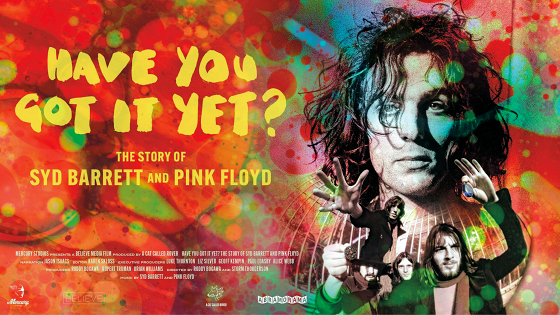
It was around 2009. I realised that I had tons of video stuff related to Syd and the early Floyd. I loved the “Have You Got It Yet?” series so much, but the quality of the video material was poor. So I thought: “If I have these videos on my hard drive, why not making the definitive video anthology covering all the 1966-69 videos? That’s the moment, when the “Ultimate Collection” DVD’s started to materialize.
I didn’t know how to make DVD’s, so I spent a huge amount of time trying to make discs. When I finished that, I shared this on Yeeshkul and was shocked by a wave of greetings from Floyd fans. In the summer of 2011 after long research and trading with collectors, I started to make an upgraded anthology – 4 DVD’s (can you imagine?). It was called “Wondering and Dreaming” and included EVERY bit of known footage of Syd Barrett on circulation.
3. How long did it take to make “Wondering & Dreaming”?
Almost 2 years. New upgrades and new videos started to appear. (Amazingly, in the summer of 2010 we got the “Dope” footage!), I became more interested in trading with other collectors, not just using sources floating on the Internet. At this time I became more professional in using video decoding, DVD authoring etc.
Every DVD of this series has liner notes, correct dates and cool picture galleries.
4. What’s your favourite video with Syd?
It’s a difficult question; honestly, I like it ALL and can’t choose. I just hope more footage to appear in the future, especially the recovered “Top of the Pops” footage.
5. What was the most difficult video to find?
Definitely “Die Jungen Nachtwandler” footage from 24.02.1967 (UFO Club). Of course, this video surfaced around 2004-5, but I was looking for a better quality copy from the Bavarian Archive. Shit! It took me four years to get it, and finally I succeeded. You can compare the quality easily and the new version rocks!
Have you noticed that Soft Machine also appears in this scene?
I also want to mention other rarities: Jugband Blues with the original soundtrack (it sounds terrible, but this is an alternate unbooted mix!), Syd’s 1969 home movies in better quality and John Latham “Speak” – Floyd 66-67 backdrop film.
6. What do you think about the recent Pink Floyd re-re-re-re-re-releases?
It was great, those guys changed their minds and gave us the chance (finally) to hear something new, not just again a “super-dooper-cool” remastering. Of course, I really want to hear more unreleased Syd music. The full December ‘64 session, Bike with alternate lyrics (and other “Piper” era early mixes), the Stockholm tape in full and the holy grail of all Syd collectors: The De Lane Lea sessions from the Fall of ‘67 (John Latham, “Intremental”, In the Beechwoods, Vegetable Man and Scream Thy Last Scream). I would pay a high price to hear all that.
7. Can you imagine Syd Barrett today and still active as a musician?
No, I just can’t imagine Syd writing songs and performing in the 80s, 90s, and 2000s. Another Roky Erikson and the Aliens? Definitely not. It was a tragedy and big loss for popular music, but... Syd belonged more to the 60s than the 70s.
Most great music was gone in 1971-72 (with the exception of some glam) and briefly returned in 1976 with punk (just my opinion). I can’t imagine Syd playing hard rock or progressive and I can’t imagine him and Pink Floyd in the 70s. By 1970 Syd's songs became darker and depressive. Songs like “Birdie Hop” or “Word Song” are difficult to listen to, you know... I think Syd said to us all what he wanted to say and that he left rock music at the right time.
8. What are your hobbies?
Just listening to music, reading books (not often). My favourite music era is the 60s: Kinks, Soft Machine, Pretty Things, lots of raw garage and R&B, proto-punk. My last major discovery is Them with Van Morrison, T2, and The Untamed. If I had a time machine, I would go back to 1965 or 66 and never return at our times again.
9. Tell us something about the Russian pop-rock panorama.
Well, there is absolutely nothing much to say about that. There is no normal pop and rock scene, just shit everywhere. “Russian Rock” is like... well... quasi-folk in the worst sense of the word, and I can't define that as rock music honestly. You can check examples of this on YouTube (Воскресение Случилось Что-То В Городе Моем or Цой - Группа крови). The only good example is some good punk rock from the USSR, there were some nice groups in the mid-80s, but mostly it was just ripped off from well-known groups like T.Rex etc...
10. What more can you say?
Just do what you want to do and feel free to express yourself. Listen to great music and keep on rockin'!
© 2012 Antonio Jesús, Solo en las Nubes. Pictures courtesy of Ewgeni Reingold. Notes & Introduction : the Holy Church of Iggy the Inuit. Translation mistakes, typos and all possible errors are entirely the responsibility of the Holy Church of Iggy the Inuit.
Wondering & Dreaming DVD Collection (written by: Ewgeni Reingold)
Almost 4 years ago I decided to make a first major DVD compilation of all Syd Barrett material in circulation. The first set was called “Ultimate Collection” and released in 2009.
But all is different now because this time I used non-compressed sources for this anthology and also because many upgrades have appeared since the last time. I decided to make the most complete picture, using all available sources (such as: there are 4 versions of “Jugband Blues” with different audio and video, 2 versions of the complete “Look Of The Week” because I can’t choose what’s the source is the best, etc...)
This 3 DVD set covers the most important years in the Syd Barrett and early Pink Floyd group history – 1966 to 1969. I also added a 4th bonus DVD with related material (such as: “Speak” by John Latham)
I would like to thank all people who help me in this project: Pete M, Ron Toon (& Harvested), Captain Bronstain for his technical help & patience, Felix Atagong & Mark Jones for his wonderful covers.
Enjoy !
Wondering & Dreaming DVD 1 (1966-67)
Torrent: http://www.yeeshkul.com/forum/showthread.php?t=26610
1. Syd’s First Trip – Summer of 1966
1.1 Source 1: VHS
1.2
Source 2: HRV (edited, best quality)
2. “San Francisco” by Anthony Stern - 1968 (ARTE rebroadcast)
3.
“Tonight Let’s All Make Love In London” – Floyd’s bits, 1967
4. London 66-67 – Filmed on 30.12.1966 (?), 11/12.01.1967, 17.01.1967 (?)
4.1
Copy from Japan Laserdisc (Interstellar Overdrive & Nick’s Boogie)
4.2
Unissued Fragment
4.3 Promo video for “London 66-67” release (1994)
4.4
Interstellar Overdrive (VH1 edited version)
5. Syd’s Silent Home Movies – 1966 or early 1967
5.1
Source 1
5.2 Source 2
Running Time: 71:18
Wondering & Dreaming DVD 2 (1967)
(same download location
as above)
1. Scene Special aka “It’s So Far Out It’s Straight Down” – filmed on
27-01-1967
1.1. Full TV Special – Broadcast on 7.03.1967, taken from
2nd Gen S-VHS
1.2. Interstellar Overdrive – without voiceover (HRV)
1.3.
Excerpts from Documentary, best ever quality
2. Excerpt from “Dope” Movie – January or February 1967
3. Excerpt from “Die Jungen Nachtwandler” Documentary, filmed on
24-02-1967
3.1 Interstellar Overdrive - Master Copy from BR
3.2
Interstellar Overdrive – VHS source
3.3 UFO Club – outtakes
4. Arnold Layne – Promo Film, Filmed in Late February 1967
4.1
Master Copy (?) (HRV)
4.2 16:9 Version
5. Beach Home Movies – Spring of 1967
5.1 Zoomed Footage
5.2
Original speed (and silent)
6. Abbey Road Home Movies – April 1967
6.1 Source 1: VHS
6.2
Source 2: HRV (edited, best quality)
7. Bouton Rouge – “Arnold Layne” Second Promo, filmed 29-04-1967
7.1
Original Non-Remastered Source
7.2 HRV Remaster
8. Look Of The Week – 14.05.1967, Source 1
8.1 Raw most
complete source – Pow.R. Toh.H., Astronomy Domine, Interview
8.2
Pow.R. Toh.H. (without logo)
Running Time: 84:50
Wondering & Dreaming DVD 3
Torrent: http://www.yeeshkul.com/forum/showthread.php?t=26725
1. Look Of The Week – 14.05.1967, Source 2 (BBC 4 rebroadcast +
different source of interview) HRV
2. Top Of The Pops (See Emily
Play) – 6.07.1967, Reconstruction
3. Pathe Newsreel (Scarecrow) – filmed on 8.07.1967
3.1
Original Complete Pathe Newsreel (21-09-1967) HRV
3.2 Scarecrow (16:9
Version)
3.3 Pathe Complete Outtakes feat. Pink Floyd, HRV
3.4
Pink Floyd Outtakes, best quality
4. Beat Club Mentions – 1967 to 1969
4.1 Hit Parade (22-07-1967)
4.2
“Reaction In G” audio from unknown source, 1969
4.3
Probably Pink Floyd footage, 1969
5. American Bandstand – 7.11.1967
5.1 Complete (Apples &
Oranges, Interview)
5.2 Excerpts without timecode
6. Central Office Of Information (Jugband Blues) – filmed on early
December 1967
6.1 Original Uncut Source with original audio
6.2
Harvested Remaster
6.3 BBC Soundtrack (fake)
6.4 “Seven Ages Of
Rock” version
7. Tomorrow’s World – Filmed on 12.12.1967
7.1 Complete
(Green Onions, Unknown song)
7.2 The Story Of Pink Floyd – first
mention, 1994
7.3 Roger Waters on Jools Holland Show (without
timecode)
8. Christmas On Earth Continued – 22.12.1967
8.1 Joe Cocker –
“With a Little Help From My friends” promo
8.2.Floyd
Footage – zoomed
9. Home Movies - Filmed Between 1966 and 1969
9.1 New Edit from best
available copy
9.2 Zoomed footage
9.3 Best quality excerpts
Running Time: 81:20
Wondering & Dreaming DVD 4 (bonus) - (1967 to 2010)
Torrent:
http://www.yeeshkul.com/forum/showthread.php?t=27280
Related Material (1967 – 1993)
1. Jeannetta Cochrane (Peter Whitehead 1967 Footage & IO soundtrack)
2.
John Latham “Speak” (Pink Floyd Backdrop 1966-67 Film)
3.
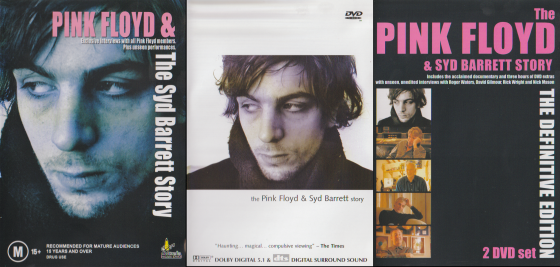
Road 1967 Footage ? (Taken from “Syd Barrett & Pink Floyd Story” DVD)
4.
Mike Leonard – Pathe Newsreel (1968)
5. Mike Leonard – Pathe
Newsreel Outtakes (1968)
6. Richard Laing ,1966 clip (Infamous Syd’s
related psychiatrist)
7. Duggie Fields, 1975 clip (Syd’s neighbor)
8.
Look At The Life, 1967 Film (feat. Iggy The Eskimo)
9. Excerpts From
Anthony Stern 1968 Movie (feat. Iggy The Eskimo)
10. Peter Whitehead
Interview (1993)
11. “A Day So Dark So Warm” – Syd’s Last Circulating
Footage (1998, Better source, than usual)
Old Documentaries (1988 - ?)
12. Dave & Rick Interview (1988)
13. Knebworth Documentary (1990,
Complete from better source, incl. 1969 Home Footage)
14. Eight Miles
High (Japan Version)
15. Eight Miles High (English VHS)
16. Eight
Miles High (Another Different Version)
Sad News (2006)
17 BBC News # 1
18. BBC News # 2
19. Sky News
20. Auction News
21.
Mick Rock talks about his Book
Oddities (2007 - ?)
22. Seven Ages Of Rock (early Floyd part only)
23. Project Syd –
Friends About Syd
24. Funny Cartoon
25. Here I Go – Promotional
Clip, 2010
Running Time: 143 Minutes
Although there are several download locations for these DVDs the Church only deliberately gives the 'official' Yeeshkul torrents. Yeeshkul is a place where Pink Floyd audio collectors meet and share files through a torrent network. Registration is needed to access the files.
Solo en las Nubes self-interviews (in English)
It is with great pleasure that the Reverend introduces a new contributor at the Holy Church of Iggy the Inuit. Not only did Antonio Jesús live in the beautiful city of Cambridge but as editor of the slightly fantastic Spanish Syd Barrett blog Solo en las Nubes he has published several Autoentrevista or Self-Interviews with Barrett specialists, biographers and friends.
Felix Atagong: an honest man
Warren Dosanjh, Syd Barrett's first manager
Kiloh Smith Interview, hosted at Syd Barrett Pink Floyd
Lee Wood, the man who knows everything
Duggie Fields, much more than a room-mate
Antonio Jesús Reyes, a new career in a new town
Wondering and Dreaming (a self-interview with Ewgeni Reingold)
Last 25 Articles
- 2012-05-11 RIP Clive Welham: a biscuit tin with knives
- 2012-03-26 Formentera Lady
- 2012-03-02 The Sixties Unplugged
- 2012-02-18 The Iggy Bank
- 2011-12-13 Happy Birthday Iggy Rose!
- 2011-12-10 Iggy Rose's Fantastic Birthday Bash!
- 2011-12-02 Fuck all that, Pink Floyd Ltd.
- 2011-11-12 Careful with that stash, Gini
- 2011-10-07 Duggie Fields, much more than a room-mate
- 2011-09-04 Lee Wood, the man who knows everything
- 2011-08-28 Immersion
- 2011-08-17 Warren Dosanjh, Syd Barrett's first manager
- 2011-08-08 Cut the Cake
- 2011-07-02 AnthropoLSD
- 2011-06-11 Mad Cat Love
- 2011-05-08 EMI blackmails Pink Floyd fans!
- 2011-05-03 Cromwellian blog launched!
- 2011-04-25 Barrett: come on you painter!
- 2011-04-15 Rockadolly
- 2011-04-10 Iggy at the Exhibition
- 2011-03-27 The Wrestling Beatle